README
Open on GitHub ↗Card reader
Real-time playing card recognition from a webcam. A YOLO11s detector, fine-tuned on a fully synthetic dataset generated from photos of one physical deck, reads the corner index (rank + suit) of cards on the table and emits JSON events.
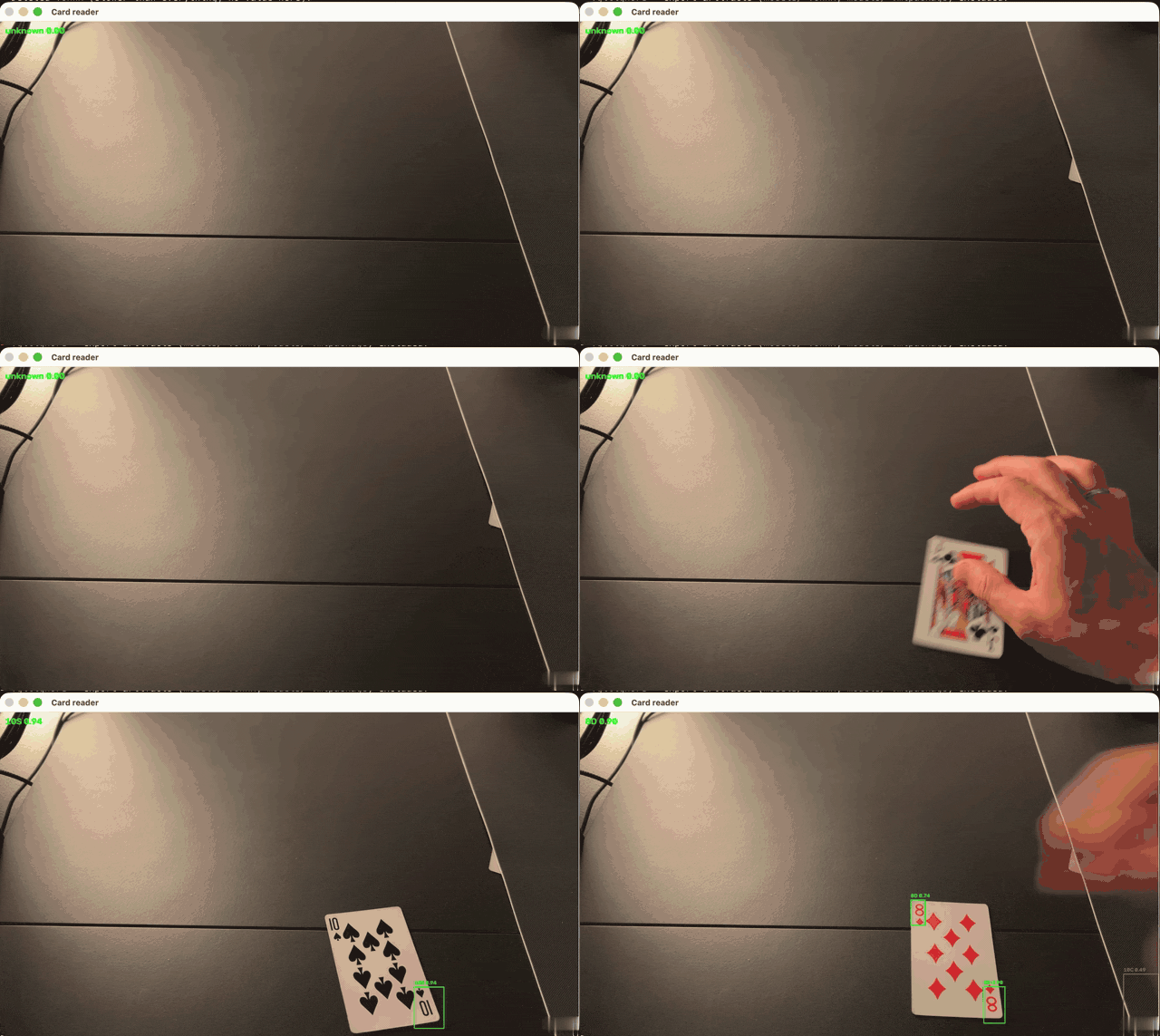
No hand-labeled data: bounding boxes come for free because the dataset generator composites card images with known geometry.
How it works
capture.py  →  extract_cards.py  →  generate_dataset.py  →  train.py  →  reader.py
 (webcam        (contour detect,      (composite cards        (fine-tune    (live
  footage of     warp each card       onto backgrounds        YOLO11s)      recognition)
  each card)     to 500×700 PNG)      with analytic labels)
capture.py— film each of the 52 cards and a few background shots
(SPACE/S to save card frames, B for backgrounds, Q to quit).extract_cards.py— finds the card contour in each frame and warps it
to a flat 500×700 PNG incards/<CARD>/.generate_dataset.py— builds a YOLO detection dataset (4,000 train /
400 val, 640×640): random cards composited onto random background crops with
rotation, scale, perspective and lighting jitter. Corner index zones are
projected through the same transform, so labels are computed, not annotated.
A random patch sometimes covers a corner (simulated finger) and that label
is dropped. Checkdataset/preview/before training — boxes must sit on
the corner glyphs.train.py— fine-tunes COCO-pretrained YOLO11s for 60 epochs. Runs
locally (Apple Silicon MPS, overnight) or on a free Colab T4 (~1–2 h, recipe
in the docstring). Result on the synthetic val set: mAP50 0.992,
mAP50-95 0.911 across 52 classes.reader.py— webcam loop. Both corners of a card vote (confidence-
weighted), a rolling window of frames must agree before aCARD_RECOGNIZEDJSON event is printed, with a cooldown against repeats.
Quick start
python -m venv .venv && source .venv/bin/activate
pip install -r requirements.txt
python reader.py   # needs models/playing_cards_custom.pt, see below
With several cameras attached, the reader window gets a "Camera" dropdown (top-right) — click it to switch feeds live. --camera 2 sets the starting camera. capture.py uses an interactive picker instead (SPACE = next, ENTER = select), same --camera flag to skip it.
Dataset & weights
- Dataset (
dataset.zip, ~370 MB): attached to the GitHub Release —
unzip and pointdata=dataset/data.yamlat it. Note:path:insidedata.yamlis absolute; fix it for your machine (e.g./content/dataset
on Colab). - Weights:
models/playing_cards_custom.pt(YOLO11s, 52 classes) is in
the repo. The raw card assets (cards/) and background shots
(backgrounds/) are included, so you can regenerate the dataset and retrain
from scratch.
Training on Colab
!pip install ultralytics
!unzip -q dataset.zip
!sed -i 's|^path: .*|path: /content/dataset|' dataset/data.yaml
!yolo detect train model=yolo11s.pt data=dataset/data.yaml epochs=60 imgsz=640
Download runs/detect/train/weights/best.pt, copy it to models/playing_cards_custom.pt. Tip: mount Google Drive and add project=/content/drive/MyDrive/card-reader so checkpoints survive runtime disconnects (resume with yolo detect train resume model=.../weights/last.pt).
Known limitations
The model is only as general as the synthetic data. It performs well in conditions matching the training distribution (this deck, dark table surface, roughly top-down camera, cards 25–65 % of frame height) and degrades on unseen surfaces, shallow/oblique camera angles, and small/distant cards. Tens are the weakest rank (two-glyph index). To adapt: capture new backgrounds and sharper card frames, widen the augmentation ranges in generate_dataset.py, regenerate, retrain.
Credits
- Detection stack: Ultralytics YOLO
(AGPL-3.0 — applies to the library and arguably to trained weights). - Earlier off-the-shelf models this project compared against:
sroot/yolo11s-playing-cards-detector,
mustafakemal0146/playing-cards-yolov8.
Code and dataset: MIT (see LICENSE).