README
Open on GitHub ↗ARM64 Assembly MNIST Digit Recognizer
This project implements a handwritten digit recognizer where the neural network inference is executed in ARM64 assembly.
The model is trained using TensorFlow/Keras, but the forward pass (dense layers, ReLU, softmax, and argmax) is implemented manually in assembly to understand how neural networks run at a low level.
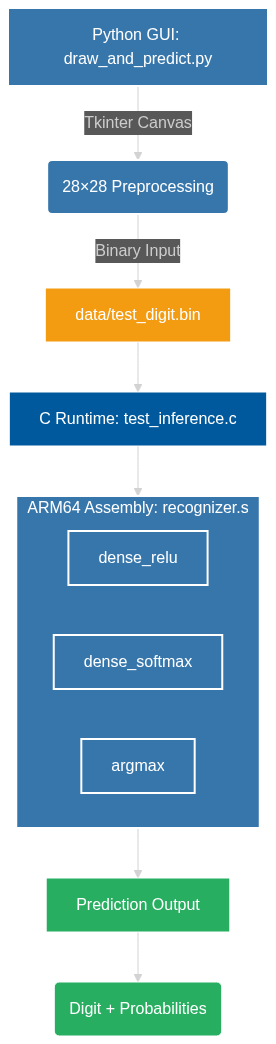
The system connects a Python drawing interface to an ARM64 inference engine through a C runtime.
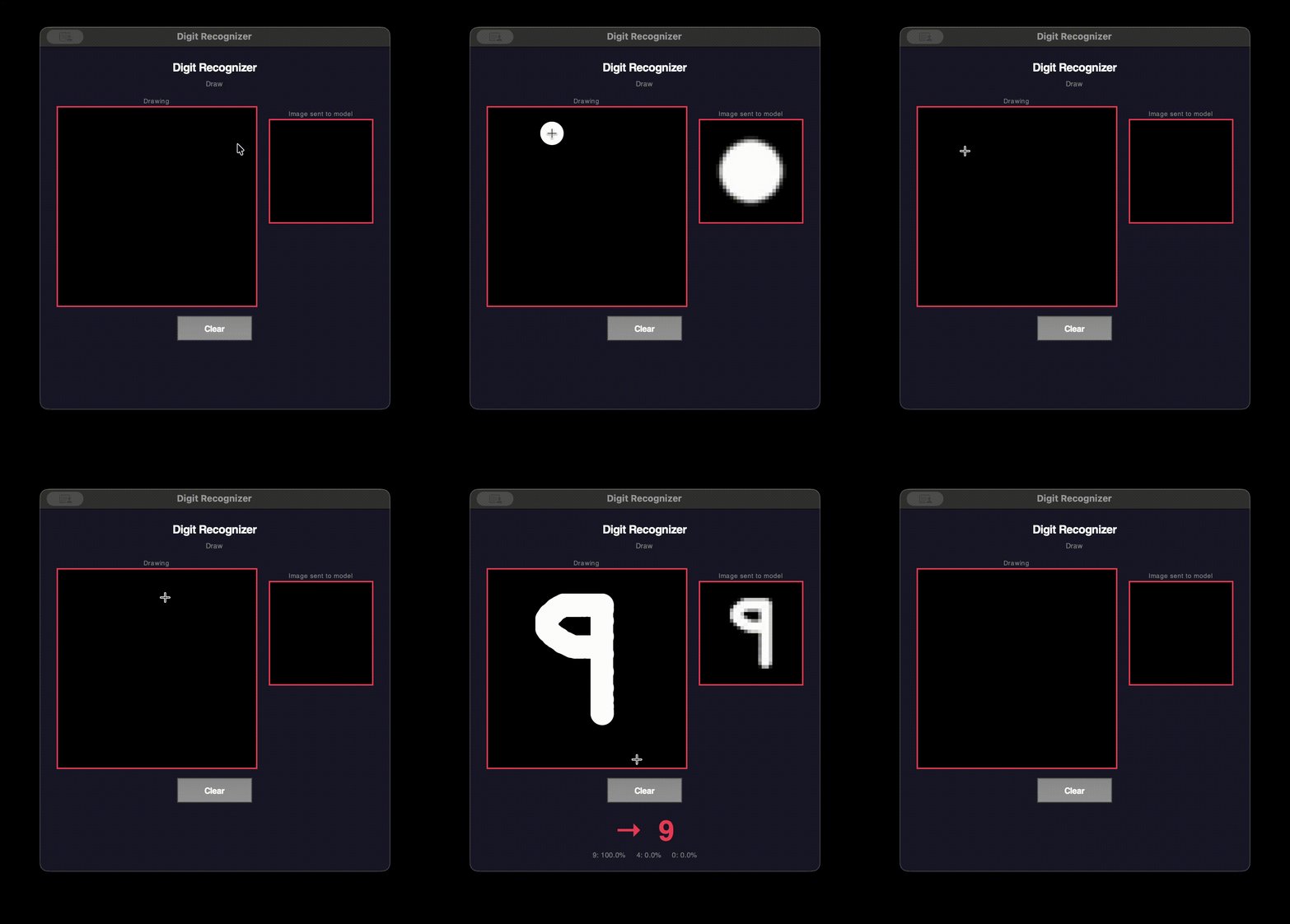
Demo
Draw a digit in the GUI and the model predicts the number in real time.
System Architecture
Neural Network Architecture
Input Layer (784 pixels)
        │
        ▼
Dense Layer (256) + ReLU
        │
        ▼
Dense Layer (128) + ReLU
        │
        ▼
Dense Layer (64) + ReLU
        │
        ▼
Dense Layer (10)
        │
        ▼
Softmax
        │
        ▼
Digit Prediction
Pipeline: Digit Prediction Flow
Click to expand: Full Step-by-Step Flow
1) Draw a Digit
User draws a digit in the Python GUI (Tkinter Canvas).
2) Convert to 28×28 Image
The drawing is transformed into a 28×28 grayscale image.
3) Flatten into Vector
The image is flattened into a 784-element vector for processing.
4) Save to Binary File
The input vector is written to a binary file (data/test_digit.bin).
5) Load Input & Weights
A C runtime loads the input and neural network weights.
6) Run ARM64 Assembly Inference
The C runtime calls ARM64 assembly kernels to compute the forward pass.
7) Output Prediction
The predicted digit and its probabilities are returned to the GUI.
Running
Start the drawing interface:
python draw_and_predict.py
Draw a digit and the model will predict it.
Technologies Used




💡 What I Learned
Neural Networks = Matrix Multiplications
Understood how neural networks fundamentally reduce to matrix operations at the core.
Inference Engine Mechanics
Learned how models execute internally and how forward passes are computed efficiently.
Low-Level Optimizations Matter
Saw how high-level ML frameworks rely on assembly-level or optimized kernels for speed.
Software Layer Integration
Explored how Python, C, and Assembly interact seamlessly to build a full-stack ML pipeline.